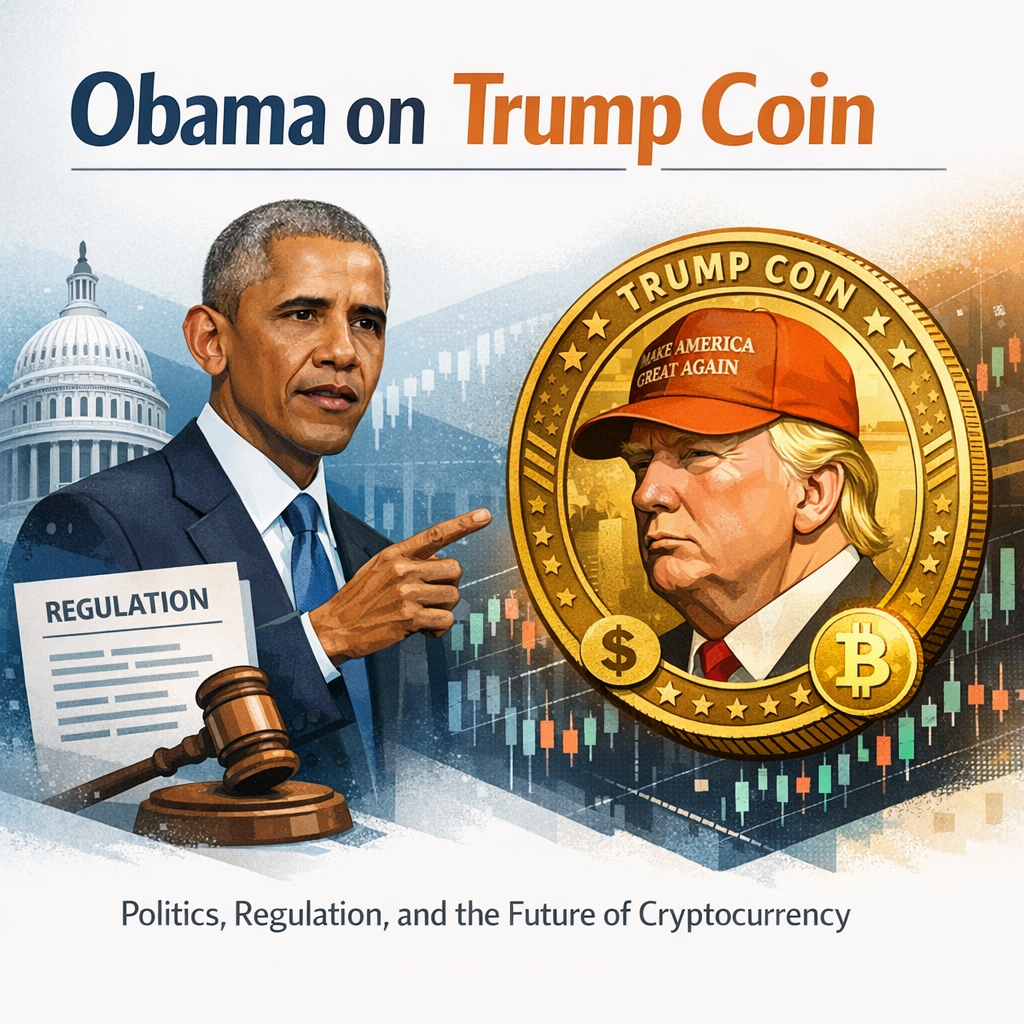
Cryptocurrency’s Growing Role in Politics
Cryptocurrency has become one of the most politically charged financial topics of the past decade. What began as a niche technological experiment has grown into a multi‑trillion‑dollar global industry that now intersects with policy, regulation, and political influence. Recently, the debate intensified when former U.S. President Barack Obama publicly criticized Donald Trump over his involvement with cryptocurrency ventures.
Speaking at a rally supporting Virginia Democratic gubernatorial candidate Abigail Spanberger, Obama accused Trump of prioritizing wealthy allies and financial insiders through crypto-related activities. The comments quickly sparked debate across political and crypto communities, raising broader questions about regulation, political influence, and the future of digital assets.
This article explores the political controversy surrounding cryptocurrency, what Obama’s criticism means, how political leadership can influence crypto markets, and what investors and everyday observers should understand about the evolving relationship between digital finance and government.
The Growing Intersection of Cryptocurrency and Politics
Cryptocurrency is no longer just a technology issue—it has become a political one. Governments around the world are grappling with how to regulate digital assets while balancing innovation, consumer protection, and economic growth.
In the United States, political parties have taken different approaches to crypto policy. Some policymakers argue that clear regulations are needed to prevent fraud, market manipulation, and financial instability. Others emphasize minimal government intervention to encourage innovation and maintain America’s competitiveness in financial technology.
Obama’s remarks highlight concerns among some Democrats that cryptocurrency markets can become vehicles for financial influence and political favoritism. During his speech, he suggested that Trump’s activities in the crypto sector were aligned more with wealthy investors and financial insiders than with the broader public interest.
This criticism touches on a broader issue: the potential for emerging financial technologies to be used as political tools. When influential political figures promote or invest in specific crypto ventures, it can raise questions about conflicts of interest, transparency, and market fairness.
To help readers better understand this intersection, a timeline infographic could be included here showing key political events that have influenced cryptocurrency regulation in the United States.
Obama’s Criticism and the Trump Crypto Debate
Obama’s Criticism of Trump’s Cryptocurrency Involvement
At the rally, Obama argued that Trump’s engagement with cryptocurrency businesses reflected a broader pattern of prioritizing wealthy supporters. According to Obama, certain crypto ventures connected to Trump and his allies could benefit individuals seeking political access or influence.
While the speech was made in the context of supporting a Democratic candidate, the message also targeted a larger political narrative: that financial systems—including crypto—should work for ordinary citizens rather than exclusively for the wealthy.
Critics of Trump have pointed to reports suggesting that individuals or entities investing in crypto projects tied to prominent political figures may be attempting to gain influence. While such claims are often difficult to prove definitively, they contribute to growing scrutiny around political figures participating in financial ventures.
Supporters of Trump, however, argue that his stance on cryptocurrency reflects support for financial innovation and economic freedom. They claim that loosening regulatory pressure can allow blockchain technologies and digital currencies to flourish in the United States.
This clash of perspectives illustrates the broader political divide around cryptocurrency: whether the industry should be tightly regulated to protect consumers or allowed greater flexibility to promote innovation.
A chart comparing Democratic and Republican policy proposals on cryptocurrency regulation could help readers visually understand the differences between these approaches.
How Political Leadership Shapes Crypto Markets
How Political Leadership Can Influence Crypto Markets
Political leadership plays a powerful role in shaping financial markets, and cryptocurrency is no exception. Regulatory signals, public statements, and policy changes can dramatically impact investor confidence and market performance.
For example, announcements regarding stricter regulations can trigger price volatility in major cryptocurrencies like Bitcoin or Ethereum. Conversely, signals that governments may adopt friendlier policies can boost market optimism.
Several factors explain why politics can strongly affect crypto markets:
First, regulation determines how easily companies and investors can operate in the sector. Licensing rules, taxation policies, and compliance requirements directly influence industry growth.
Second, political messaging can influence investor sentiment. When influential leaders endorse or criticize cryptocurrency, it can shape public perception and investor behavior.
Third, global competition between countries to attract blockchain innovation can drive policy decisions. Nations such as Singapore, the United Arab Emirates, and Switzerland have developed crypto-friendly regulatory environments to attract startups and investment.
In the United States, ongoing debates in Congress and the executive branch continue to shape the regulatory landscape. As a result, political developments often ripple through crypto markets almost instantly.
An infographic showing how major political announcements historically affected Bitcoin prices could be particularly useful in this section.
Debates Within the Cryptocurrency Community
The Debate Within the Crypto Community
The controversy surrounding Obama’s criticism of Trump has also sparked intense debate within online cryptocurrency communities. Investors and analysts often disagree on how political leadership affects the crypto market.
Some participants argue that political instability or unclear policies create uncertainty that discourages investment. They believe that consistent regulations and transparent oversight are necessary for long-term market growth.
Others claim that heavy regulation could undermine the decentralized ethos of cryptocurrency and restrict innovation. From this perspective, political interference—regardless of which party is responsible—can hinder the industry’s potential.
These debates reflect a deeper philosophical divide about the role of government in emerging financial systems. While some investors prioritize market freedom, others emphasize consumer protection and stability.
Real-world examples highlight the complexity of these discussions. In several cases, cryptocurrency exchanges have faced regulatory crackdowns that led to major market fluctuations. At the same time, countries with clearer regulatory frameworks have seen increased institutional investment in blockchain technology.
A table comparing regulatory approaches in different countries could help readers better understand how policy differences affect crypto adoption.
Navigating Political Influence in Crypto Markets
Practical Tips for Navigating Political Influence in Crypto Markets
For investors and readers trying to understand the impact of politics on cryptocurrency, a few practical strategies can help reduce confusion and risk.
First, focus on fundamentals rather than political hype. Cryptocurrency markets often react strongly to political headlines, but long-term value tends to depend on technology, adoption, and real-world use cases.
Second, diversify investments. Political developments can create sudden volatility, so spreading investments across multiple assets can reduce risk.
Third, stay informed about regulatory changes. Government policies regarding taxation, exchange regulation, and digital asset classification can significantly affect market conditions.
Fourth, verify information carefully. Social media discussions about politics and crypto can quickly become polarized or exaggerated, so relying on credible sources is essential.
In this section, a simple checklist graphic could help readers remember key steps for managing risk in politically influenced markets.
The clash between Barack Obama and Donald Trump over cryptocurrency highlights how deeply digital finance has entered the political arena. What was once considered a niche technological movement is now intertwined with debates about regulation, economic fairness, and political influence.
Obama’s criticism reflects concerns about wealth concentration and potential conflicts of interest in emerging financial systems. Meanwhile, supporters of more open crypto policies argue that innovation and economic freedom require fewer regulatory barriers.
As cryptocurrency continues to grow, the role of political leadership will likely become even more significant. For investors, policymakers, and everyday citizens, understanding the relationship between politics and digital finance will be essential for navigating the future of the global economy.
Ultimately, the debate is not just about one political figure or one rally speech. It is about how societies choose to manage powerful new financial technologies—and who benefits from them.
References and Further Reading
Readers interested in exploring this topic further may consider reviewing reports and analysis from organizations such as the Brookings Institution, the Congressional Research Service, and the International Monetary Fund regarding cryptocurrency regulation and financial policy.
Major financial publications including Bloomberg, Reuters, and The Wall Street Journal also regularly cover the intersection of politics and cryptocurrency markets.
Additionally, academic research on blockchain governance and regulatory frameworks can provide deeper insight into how governments and financial systems are adapting to the rise of digital assets.