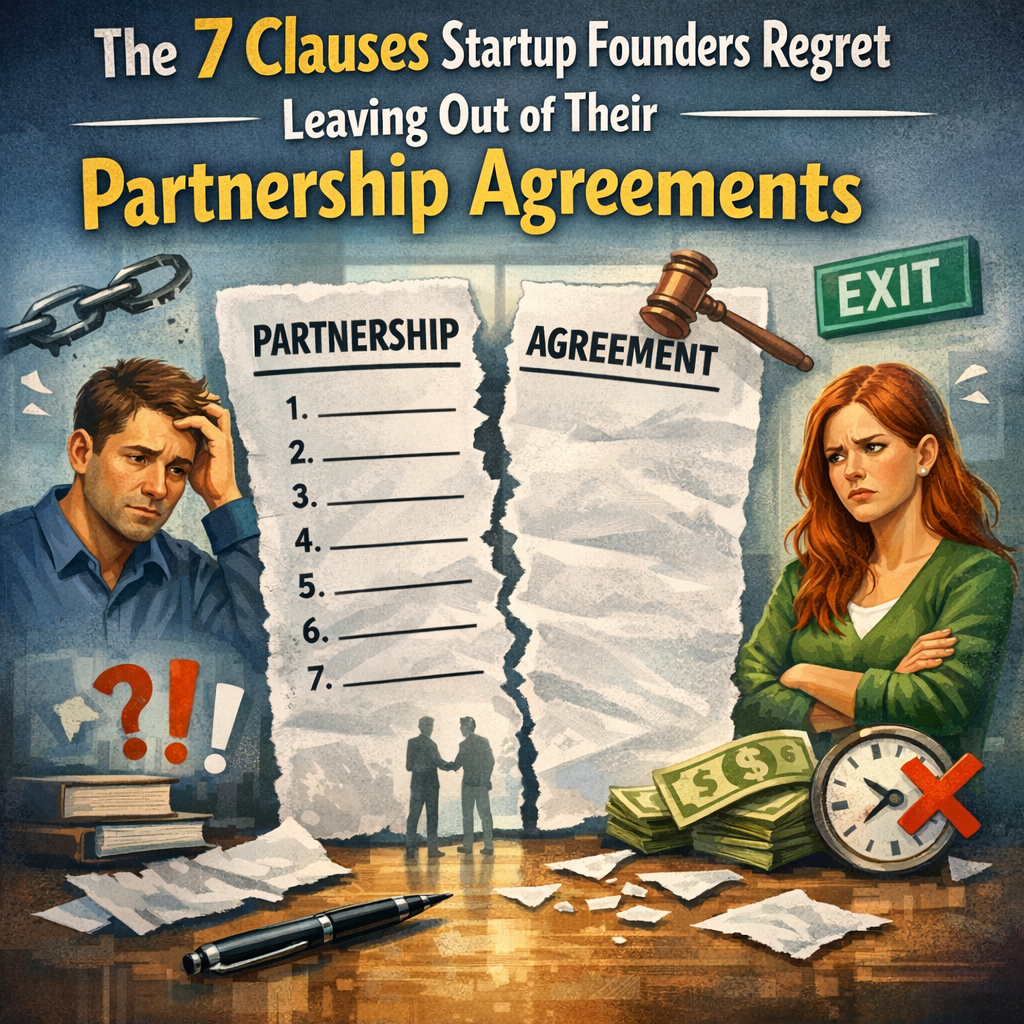
Why Agreements Matter From Day One
Most startup breakups don’t happen because the idea failed—they happen because the relationship did. Two people start out aligned, energized, and optimistic. Then reality hits: uneven workloads, unclear expectations, money stress, and suddenly that “we’ll figure it out” mindset turns into resentment.
The uncomfortable truth is this: handshake deals feel fast and friendly in the beginning, but they’re often just delayed conflict. A cofounder agreement isn’t about distrust—it’s about clarity. And clarity is what allows great partnerships to survive pressure.
In this article, you’ll learn why a cofounder agreement matters from day one, the key areas every founder must define early, and how to structure agreements that prevent common (and costly) mistakes.
The Risk of Waiting and Default Rules
Early-stage founders often delay formal agreements for understandable reasons. They’re moving fast, testing ideas, or simply unaware that such agreements exist. Others feel it’s too early because “there are too many unknowns.”
But here’s what actually happens when you don’t define things: the law steps in and defines them for you. In most jurisdictions, default rules assume equal ownership and equal decision-making power—regardless of who contributed what.
Imagine building 90% of the product while your cofounder contributes sporadically. Without an agreement, both of you may legally own 50%. That mismatch is where frustration begins.
A cofounder agreement isn’t a rigid contract carved in stone. It’s a living document. You can—and should—update it as your startup evolves. But starting without one means starting with invisible rules you didn’t choose.
(Suggested visual: a simple diagram showing “Handshake Agreement vs. Written Agreement” outcomes.)
Money, Ownership, and Contributions
Money conversations are where most cofounder relationships quietly fracture. Not because of greed, but because of ambiguity.
Every agreement should clearly answer three questions: who is contributing what, when people get paid, and what happens if someone leaves.
First, contributions. Not all equity is earned through cash. One founder may invest money, another may invest time and expertise. Both are valuable—but they are not the same, and pretending they are leads to tension. Spell it out explicitly.
Second, distributions. Many startups don’t generate profit immediately. So what happens when revenue does come in? Is it reinvested into growth, or can founders withdraw income? Without clarity, one founder may want to scale while another wants liquidity.
Third, buyouts. This is where many founders make a critical mistake: assuming they’ll “figure it out later.” But later is exactly when emotions run highest. A pre-agreed valuation formula (for example, tied to revenue or a multiple) removes guesswork and reduces conflict.
A real-world example: in several early-stage SaaS startups, disputes arose not over equity splits, but over when founders could start paying themselves. Those that had predefined rules avoided conflict entirely; those that didn’t often split.
(Suggested visual: a simple flowchart of “Founder Leaves → Predefined Buyout Formula vs. Negotiation Chaos.”)
Intellectual Property and Decision-Making
This is one of the most overlooked—and most dangerous—areas.
By default, intellectual property belongs to the person who created it, not the company. That means the developer who wrote your code technically owns it unless they formally assign it to the business.
This becomes a serious issue when investors enter the picture. Investors don’t fund ideas—they fund assets. And if your startup doesn’t clearly own its own IP, that’s a red flag.
Every founder and contractor should sign an IP Assignment Agreement. This ensures that anything they create for the business—code, branding, designs, inventions—is owned by the company itself.
There’s also a common early-stage trap: pre-incorporation work. Maybe you built your prototype in a dorm room or during weekends before forming the company. That work must be formally assigned to the company after incorporation. Otherwise, ownership remains personal.
In due diligence processes, unclear IP ownership has delayed or even killed funding rounds. Fixing it later is possible—but far more painful than doing it upfront.
(Suggested visual: timeline showing “Pre-incorporation work → Assignment → Company ownership.”)
“We’re equal partners” sounds fair, but equality without structure can stall a company.
If two founders each hold 50% and disagree, who decides? Without a mechanism, the answer is often: no one. That’s how startups freeze at critical moments.
Strong agreements separate types of decisions. Day-to-day operations might fall under one founder, while strategic decisions require joint approval. This creates efficiency without sacrificing alignment.
But even with defined roles, disagreements happen. That’s why deadlock mechanisms are essential.
One common approach is appointing a trusted third party—an advisor or board member—with tie-breaking authority. Another is a “shotgun clause,” where one founder offers to buy out the other at a specific price, and the other must either accept or buy them out at the same valuation.
These mechanisms aren’t meant to be used frequently. Their existence alone often prevents disputes from escalating, because both parties know there’s a clear resolution path.
Vesting, Exits, and Practical Next Steps
One of the biggest mistakes founders make is granting equity upfront with no conditions attached.
People’s circumstances change. A cofounder might leave after six months for a more stable job or personal reasons. Without vesting, they could walk away with a large ownership stake despite limited contribution.
That’s why standard vesting schedules exist. The most common is four years with a one-year cliff. If a founder leaves before one year, they receive nothing. After that, equity vests gradually over time.
This structure aligns incentives. It rewards long-term commitment and protects those who continue building the company.
Another area to address is focus. What does “full-time” actually mean? Can founders work on side projects? What qualifies as a conflict of interest?
These questions may feel unnecessary early on, but they become critical as the company grows. Defining them upfront prevents misunderstandings later.
No one starts a company expecting conflict or departure—but both are common.
A strong agreement plans for exits while relationships are still positive.
If a founder wants to sell their shares, a Right of First Refusal ensures the company or remaining founders can buy them before an outside party steps in. This prevents unwanted partners from entering the business.
Dispute resolution is equally important. Agreeing to mediation before litigation can save significant time, money, and stress. Lawsuits are expensive and public; mediation is often faster and more collaborative.
There are also edge cases founders tend to avoid discussing—like disability or death. While uncomfortable, addressing them ensures continuity and stability for the company and stakeholders.
Start simple but be explicit. You don’t need a 50-page legal document on day one, but you do need clarity on ownership, roles, and expectations.
Revisit the agreement regularly. As your startup evolves, your agreement should too. Set checkpoints—every six or twelve months—to review and update it.
Use professionals when needed. Templates are a good starting point, but a startup attorney can help you avoid blind spots, especially around IP and equity.
Have the hard conversations early. It’s far easier to discuss equity splits, exits, and responsibilities when things are going well than when tensions are high.
Balance trust with structure. One common argument is that needing a contract early signals a lack of trust. In reality, the opposite is true—clear agreements protect trust by removing ambiguity.
(Suggested formatting: a short checklist or numbered list summarizing these steps.)
Some argue that formal agreements too early can be counterproductive—that you should wait a year to see if the partnership works.
There’s some truth here: not every collaboration needs to start with a fully legalistic structure. Early experimentation can help founders test compatibility.
But waiting entirely carries risk. A practical middle ground is to create a lightweight agreement early, then formalize it as commitment deepens. This preserves flexibility without leaving critical issues undefined.
Think of it less as locking things in and more as writing down your current understanding—one that can evolve with the business.
Startups are inherently uncertain. Markets shift, products pivot, and strategies evolve. But one thing you can control is how you and your cofounders work together.
A cofounder agreement isn’t about expecting failure—it’s about building resilience. It ensures that when challenges arise, you’re solving business problems, not personal disputes.
The best time to create one isn’t when something goes wrong. It’s when everything still feels easy.
If you’re building something with someone else, take the time to write it down. Your future self—and your partnership—will thank you.
For deeper exploration, consider resources like Y Combinator’s Startup Library (guidance on founder equity and agreements), the National Venture Capital Association (model legal documents), and books such as “Venture Deals” by Brad Feld and Jason Mendelson.
Startup legal blogs and firms like Cooley, Wilson Sonsini, and Andreessen Horowitz also publish practical guides on founder agreements, vesting, and IP considerations.