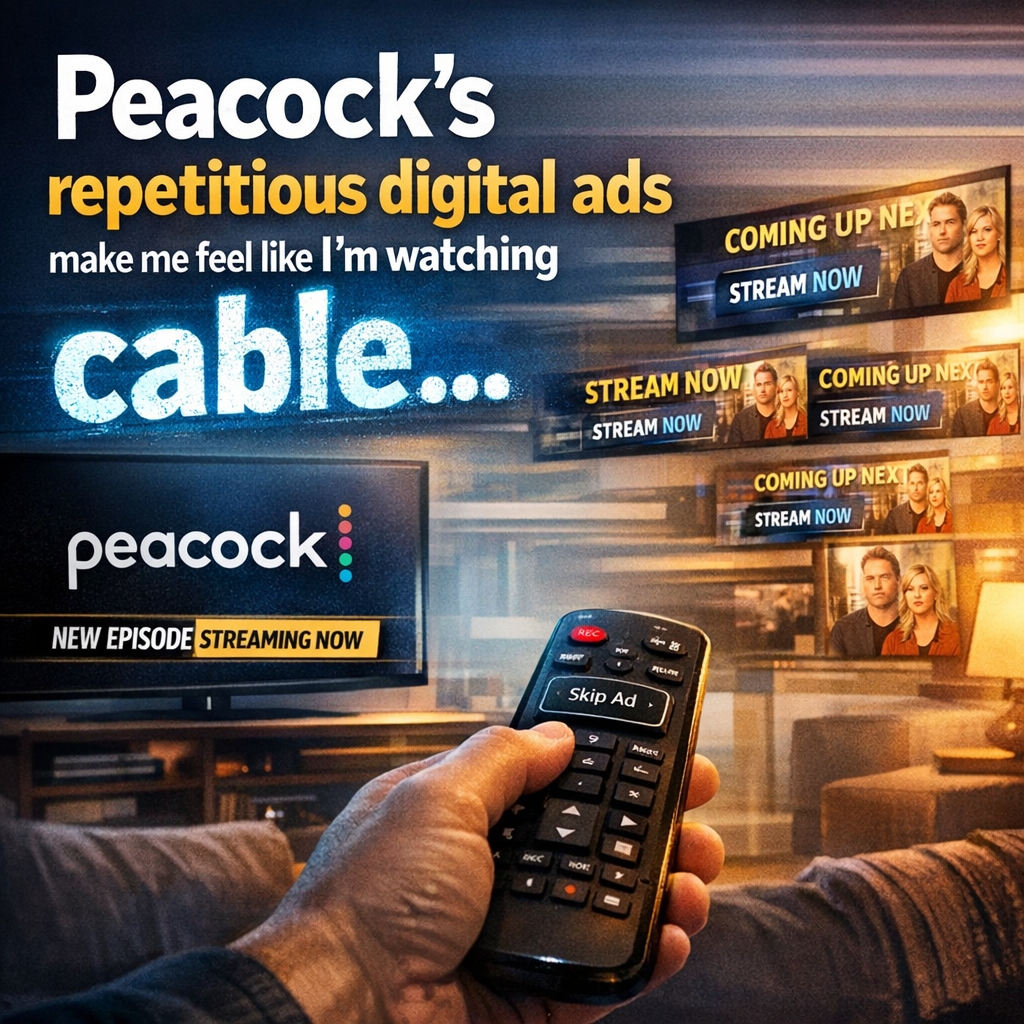
The Frustration of Repetition in Streaming Ads
There’s a particular kind of frustration that only modern streaming can deliver: you sit down to relax, press play, and within minutes you’re watching the exact same ad you saw five minutes ago… and then again… and again. It’s not just annoying—it starts to feel like a glitch in reality. For many viewers, platforms like Peacock have turned ad repetition into a defining part of the experience, raising a bigger question: does showing the same handful of ads over and over actually work?
This article explores why repetitive digital advertising feels so suffocating, how it impacts consumer perception, and what platforms and advertisers could do differently. Along the way, we’ll look at how this issue isn’t new, why the “just pay for no ads” argument misses the point, and what smarter ad strategies might look like in a streaming-first world.
When Repetition Turns from Persuasion to Irritation
At its core, advertising is about persuasion. But persuasion depends on timing, context, and variety. When viewers are shown the same ad repeatedly within a short timeframe—sometimes multiple times in a single episode—it crosses a line from persuasion into irritation.
Research in advertising psychology suggests that repetition can improve recall, but only up to a point. This is often referred to as the “wear-out effect.” Once an ad is seen too frequently, its effectiveness drops sharply, and it can even create negative associations with the brand. Instead of thinking, “I should check that out,” viewers begin to think, “If I see this one more time, I’m going to lose it.”
Streaming platforms, unlike traditional TV, have the data and technology to avoid this problem. Yet many still rely on limited ad rotations, leading to scenarios where viewers are served the same four ads repeatedly. The result isn’t just boredom—it’s active resentment.
(Suggested visual: A simple chart showing ad effectiveness rising with repetition, then dropping after a certain threshold.)
Why Streaming Platforms Still Get It Wrong
It might seem surprising that in an era of personalized algorithms and targeted content, ad experiences can feel so primitive. The issue often comes down to inventory and targeting constraints.
Streaming platforms sell ad space based on audience segments. If a platform has limited advertisers targeting a specific demographic, it may end up recycling the same ads because there simply aren’t enough alternatives in that category. This is especially common on smaller or newer platforms that haven’t fully scaled their advertising ecosystems.
Another factor is frequency capping—or the lack of it. Frequency capping is a standard digital advertising practice that limits how often a user sees the same ad within a given time period. When poorly implemented or ignored, viewers can end up seeing the same creative dozens of times in a single session.
There’s also a legacy mindset at play. Traditional television often relied on heavy repetition, under the assumption that more exposure equals better recall. While that may have worked in the 90s when viewers had fewer choices, today’s audiences are far less captive. With endless alternatives at their fingertips, annoyance can quickly lead to disengagement.
(Suggested visual: A flow diagram showing how ad inventory, targeting, and frequency capping interact in streaming platforms.)
The Real Impact of Ad Fatigue on Brands
The short answer: not in the way advertisers hope.
While repeated exposure can increase brand recognition, excessive repetition often damages brand perception. Studies from marketing research firms like Nielsen and Kantar have shown that ad fatigue leads to lower engagement, reduced purchase intent, and even negative brand sentiment.
Think about it in real terms. If you’ve seen the same ad 50 times in a week, you’re not more likely to buy the product—you’re more likely to mute it, mock it, or mentally tune out anything associated with it. The creative work behind the ad becomes irrelevant because the delivery method overwhelms it.
This creates a paradox: creative teams invest time and effort into making compelling, memorable ads, only for those ads to become unbearable through overexposure. The issue isn’t the quality of the ad—it’s how it’s being used.
What Streaming Should Have Learned from Traditional TV
For anyone who grew up watching MTV, Comedy Central, or VH1 in the 90s, this problem feels familiar. Back then, viewers had little control. If the same ads played repeatedly, you either watched them or left the room.
Streaming was supposed to change that. With better data, platforms could theoretically deliver more relevant, diverse, and less intrusive ad experiences. Instead, in many cases, the same old patterns have been recreated in a new format.
The key difference is that today’s viewers have much lower tolerance for annoyance. They can switch platforms, abandon shows, or upgrade their subscriptions instantly. This makes poor ad experiences more damaging than ever.
And importantly, telling users to “just pay for no ads” sidesteps the real issue. Ad-supported tiers are a legitimate and valuable option for many viewers. The goal shouldn’t be to push people away from them—it should be to make them better.
Smarter Ways to Fix the Ad Experience
Improving the streaming ad experience doesn’t require reinventing advertising—it just requires smarter execution.
One approach is front-loading ads. Instead of interrupting content every few minutes, platforms could offer a longer ad block at the beginning, allowing for uninterrupted viewing afterward. Many viewers would gladly trade a few minutes upfront for a smoother experience.
Another solution is creative rotation. Platforms should ensure that viewers are exposed to a wider variety of ads, even within the same targeting category. This reduces fatigue and keeps the experience feeling fresh.
Frequency capping also needs to be taken seriously. Limiting how often a single ad appears within a session—or even across multiple sessions—can dramatically improve user satisfaction without sacrificing effectiveness.
Finally, interactive and contextual ads offer a more engaging alternative. Ads that relate to the content being watched or allow for some form of viewer interaction can feel less intrusive and more relevant.
(Suggested visual: A comparison graphic showing “current ad experience” vs. “optimized ad experience.”)
For viewers, there are a few ways to manage ad fatigue. Switching profiles or devices can sometimes reset ad targeting. Providing feedback through platform settings can also help improve future ad delivery, though results vary. In some cases, rotating between platforms can reduce overexposure to specific campaigns.
For platforms and advertisers, the path forward is clearer. Invest in better ad variety, implement strict frequency caps, and prioritize user experience alongside revenue. Consider experimenting with alternative formats, such as fewer but longer ad breaks, or offering viewers some control over the ads they see.
(Suggested formatting: A short numbered list could be added here to clearly outline steps for improving ad delivery strategies.)
Repetition in advertising isn’t inherently bad—but unchecked repetition is. When viewers are bombarded with the same ads over and over, the result isn’t better brand recall—it’s frustration, disengagement, and negative sentiment.
Streaming platforms have the tools to do better. With smarter targeting, better frequency management, and more creative ad strategies, they can create experiences that feel less like interruptions and more like a natural part of the content ecosystem.
At the end of the day, advertising should support the viewing experience, not sabotage it. If platforms want to keep audiences engaged—and advertisers want their messages to land—it’s time to move beyond the “same four ads on repeat” model and build something more thoughtful.
Further Reading and Research on Ad Effectiveness
For those interested in exploring this topic further, consider looking into research from Nielsen on ad frequency and effectiveness, Kantar’s studies on ad fatigue, and industry reports on connected TV (CTV) advertising trends. Publications like Adweek, Marketing Dive, and Harvard Business Review also regularly cover evolving strategies in digital advertising.
(Suggested addition: A small table or list of key studies and their findings could be included here for readers who want deeper insights.)