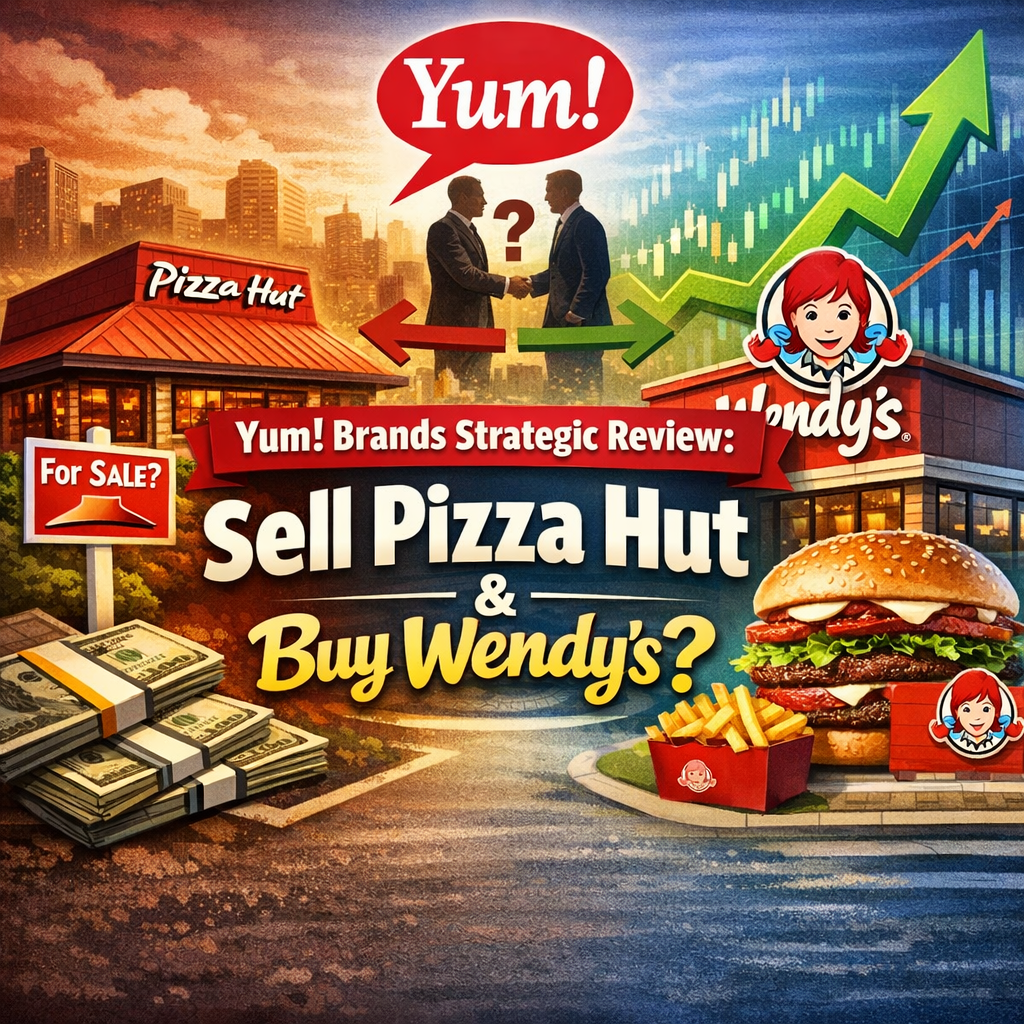
A Strategic Review That Signals Bigger Intentions
Yum! Brands dropping the phrase “strategic review” about Pizza Hut is the kind of corporate signal that makes investors lean forward. It’s rarely just a routine check-in—it usually hints at something bigger: a sale, a spin-off, or a meaningful reset. But what if this move isn’t just about shedding a struggling asset? What if it’s the first step toward a bold pivot—like acquiring Wendy’s?
This idea might sound speculative at first, but when you connect the dots—market positioning, leadership overlap, valuation gaps, and Yum’s track record—it starts to look surprisingly plausible. In this article, we’ll unpack why a Pizza Hut divestiture could open the door to a Wendy’s acquisition, where the strategy makes sense, where it could fall apart, and what it all means for investors watching the fast-food landscape evolve.
Pizza Hut was once a dominant force in the global pizza market, but its relevance has faded over the years. While competitors like Domino’s leaned aggressively into digital ordering, delivery optimization, and streamlined menus, Pizza Hut remained tied to a legacy footprint—particularly its dine-in locations, many of which now feel outdated.
Consumer sentiment reflects this decline. Many customers view the brand as overpriced or inconsistent in quality, with some locations struggling to maintain basic standards. Meanwhile, Domino’s has surged ahead in both sales and brand perception, leaving Pizza Hut playing catch-up.
From Yum’s perspective, this creates a portfolio imbalance. Taco Bell continues to outperform, driving growth and innovation, while KFC maintains a strong global presence despite increased competition. Pizza Hut, by contrast, has become a drag on momentum.
A “strategic review” signals that Yum is openly questioning whether Pizza Hut still fits its long-term vision. The likely outcomes include:
• Selling the brand to another operator
• Spinning it off as a separate company
• Refranchising or restructuring aggressively
Any of these paths could unlock capital—and that’s where the Wendy’s idea enters the picture.
Why Wendy’s Could Be the Missing Piece
Yum! Brands operates globally with a franchise-heavy model and a focus on scalable concepts. One thing it doesn’t have, however, is a burger chain. That absence is notable, especially when compared to Restaurant Brands International (RBI), which owns Burger King, Popeyes, and Tim Hortons—a diversified lineup spanning multiple fast-food categories.
Acquiring Wendy’s would immediately fill that gap.
Wendy’s sits in an interesting position. It’s a well-known brand with strong heritage, but its growth has been uneven. The company is currently working through a turnaround strategy—often referred to as “Project Fresh”—aimed at modernizing stores, improving operations, and re-energizing the brand. Despite these efforts, the market hasn’t fully rewarded the stock with a premium valuation.
This creates an opportunity. Yum has a history of scaling brands through franchising and international expansion. Taco Bell is a prime example—once primarily U.S.-focused, it has become a global growth engine under Yum’s leadership.
There’s also a leadership connection worth noting. Greg Creed, former CEO of Yum and Taco Bell, is now consulting for Wendy’s. While that doesn’t guarantee anything, it does suggest a shared strategic language and familiarity that could make a deal more feasible.
If Yum were to acquire Wendy’s, the strategic benefits could include:
• Immediate entry into the burger category
• Expanded U.S. market strength
• Opportunities for international franchising growth
• Cross-brand operational efficiencies
An infographic here could illustrate how Yum’s current portfolio compares to competitors like RBI, highlighting the missing burger segment.
The Risks and Challenges Behind the Strategy
As compelling as the strategy sounds, it’s far from risk-free. The fast-food burger segment is one of the most competitive spaces in the industry. McDonald’s dominates globally, while chains like Chick-fil-A, Shake Shack, and regional players continue to chip away at market share.
Wendy’s itself has struggled with consistency. Some customers feel the brand has leaned too heavily on gimmicky menu items rather than focusing on core quality—an issue that can dilute brand identity over time.
Integration risk is another major concern. Merging two large organizations involves aligning:
• Corporate cultures
• Technology systems
• Supply chains
• Franchisee relationships
Even well-planned acquisitions can stumble during this phase. A case study comparison chart showing successful vs. failed restaurant mergers could add useful context here.
There’s also the regulatory angle. Increased consolidation in the fast-food industry could attract scrutiny, especially if it reduces competition in certain markets.
Finally, Yum has alternative uses for its capital. Instead of pursuing a large acquisition, the company could double down on:
• Digital ordering and loyalty platforms
• Delivery infrastructure
• Taco Bell expansion
• KFC international growth
Each of these options carries less risk than a major acquisition.
How the Scenario Could Unfold
If Yum were to pursue this strategy, the process would likely unfold in stages:
First, Yum completes the Pizza Hut review and decides on a divestiture path, freeing up capital and management focus.
Second, the company evaluates acquisition targets, with Wendy’s emerging as a candidate due to valuation, brand recognition, and strategic fit.
Third, preliminary discussions or partnerships could begin—potentially leveraging existing relationships like Greg Creed’s advisory role.
Fourth, Yum would structure a deal, likely involving a mix of cash and stock, while preparing for regulatory review.
Finally, post-acquisition integration would focus on franchising expansion, cost efficiencies, and brand repositioning.
A timeline graphic would work well here to help readers visualize each stage.
What It Means for Investors Watching the Industry
For investors, situations like this are less about predicting a single outcome and more about understanding probabilities and positioning accordingly.
Pay close attention to Yum’s language in earnings calls and filings. Subtle shifts in tone around Pizza Hut or capital allocation can signal intent.
Watch Wendy’s valuation and performance metrics. If the turnaround gains traction, the acquisition window could narrow quickly.
Look for insider or executive movement. Leadership changes often precede strategic shifts.
Consider the broader industry context. Trends in digital ordering, delivery, and franchising economics will influence whether a deal makes sense.
And most importantly, avoid overcommitting to speculative scenarios. Even well-reasoned ideas like this one may never materialize.
A simple comparison table showing key metrics (valuation, growth rates, margins) between Yum, Wendy’s, and competitors could help ground investment decisions.
Yum’s review of Pizza Hut may seem like a routine corporate adjustment, but it could mark the beginning of a larger strategic shift. Selling or spinning off Pizza Hut would not only streamline the company’s portfolio—it could also create the financial and operational flexibility needed for a bold acquisition.
Wendy’s, with its recognizable brand and untapped potential, fits that narrative surprisingly well. The idea isn’t without risks, and execution would be critical. But if Yum is serious about diversifying and accelerating growth, this kind of move would align with its history of transforming and scaling restaurant brands.
Whether or not this specific scenario plays out, one thing is clear: the fast-food industry is entering another phase of consolidation and reinvention. Investors who pay attention to these early signals may be better positioned to understand where the next wave of growth will come from.
References and Further Reading
For those interested in digging deeper, consider reviewing Yum! Brands’ latest earnings reports and investor presentations, Wendy’s corporate strategy updates, and industry analyses from sources like McKinsey, Deloitte, and QSR Magazine. Financial data platforms such as Bloomberg or Yahoo Finance can also provide useful valuation and performance comparisons.