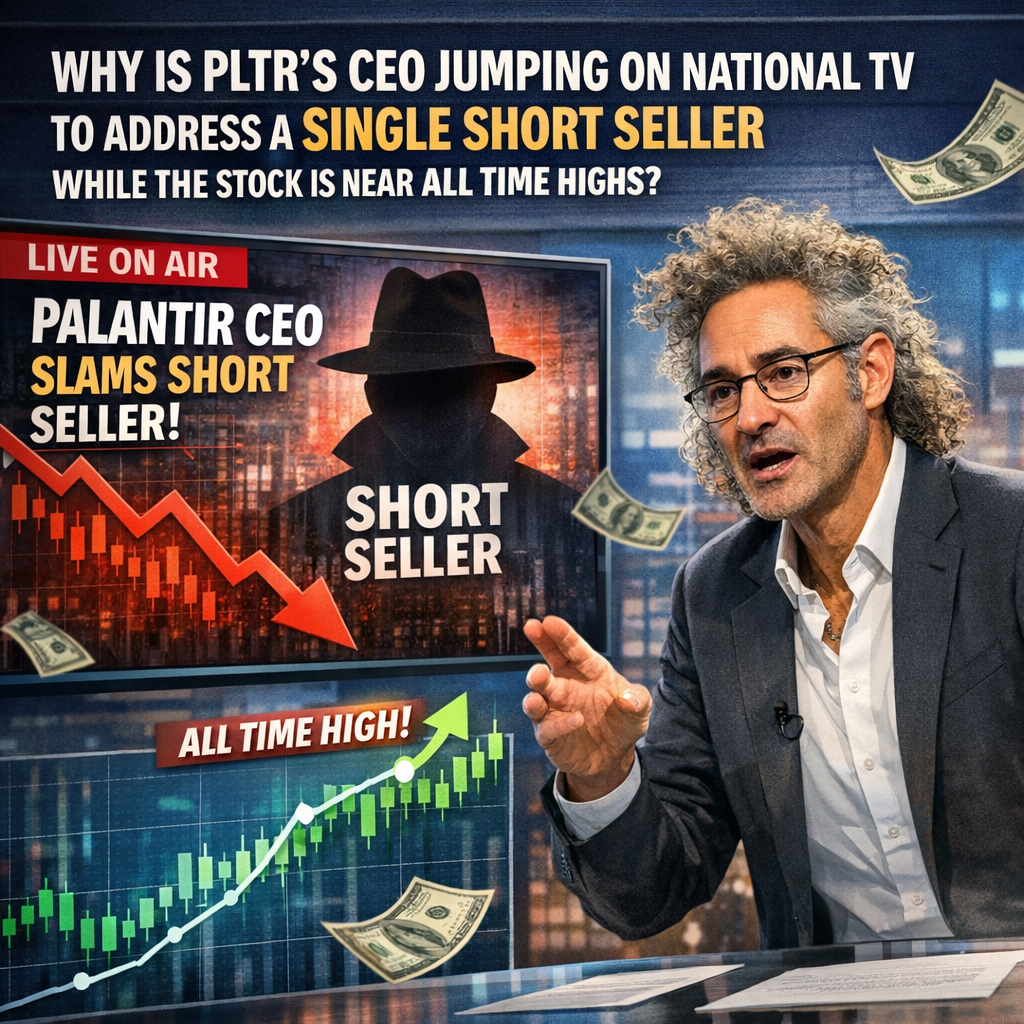
A Public Clash That Signals Deeper Tensions
When a CEO goes on national television right after earnings and publicly calls a high-profile investor a “lunatic,” it’s bound to raise eyebrows. That’s exactly what happened when Palantir CEO Alex Karp took aim at Michael Burry—the famed investor behind “The Big Short.” The clash wasn’t just entertaining; it opened up a deeper conversation about market narratives, valuation tensions, and the uneasy relationship between corporate leaders and short sellers.
So what’s really going on here? Is this just media noise, or does it signal something more meaningful about Palantir, its valuation, and how executives respond to criticism? In this article, we’ll unpack the situation, explore why it matters, and give you a clearer lens for interpreting these kinds of public market conflicts.
Why This Exchange Matters More Than It Seems
At first glance, the situation seems straightforward: a CEO defending his company after earnings while responding to a well-known critic. As one observer pointed out, this could simply be framed as a routine post-earnings interview where broader questions were asked. That’s not unusual—CEOs frequently appear on CNBC or Bloomberg after reporting results.
But the tone is what stands out. Calling Michael Burry—a figure known for accurately predicting the 2008 financial crisis—a “lunatic” isn’t typical corporate communication. Public company CEOs are usually highly measured, especially when discussing critics or short sellers.
This matters because tone can reveal underlying pressure. When a company is performing strongly—Palantir is near all-time highs and generating roughly $4 billion in annual revenue—you’d expect confidence to show up as restraint, not confrontation.
The key question becomes: why engage so directly at all?
Fundamentals vs. Expectations in the Karp-Burry Dynamic
Michael Burry isn’t just another skeptic on social media. His reputation comes from identifying systemic mispricing before the broader market catches on. When someone like Burry takes a short position or criticizes a company, it carries symbolic weight—even if he’s ultimately wrong.
Karp’s response highlights a deeper tension between corporate leadership and short sellers:
Short sellers challenge narratives. They question growth assumptions, margins, and long-term viability. CEOs, on the other hand, are incentivized to project confidence and defend their strategy.
In this case, Karp reportedly pushed back by pointing out that the companies Burry is shorting are “making all the money.” Critics quickly countered that $4 billion in revenue, while impressive, doesn’t automatically justify Palantir’s valuation—especially compared to high-growth tech peers.
This exchange reflects a classic market divide: fundamentals versus expectations.
The Business Model Debate Driving Valuation Questions
One of the most persistent debates around Palantir is what it actually is. Is it a scalable software company, or is it closer to a services firm dressed in software branding?
Some critics argue that Palantir’s “Forward Deployed Engineers” model—where engineers work closely with clients to implement solutions—resembles consulting or “body shop” work more than traditional software scaling. In pure software businesses, margins tend to expand rapidly as products scale. In service-heavy models, growth often requires proportional increases in labor.
This distinction matters because valuation hinges on it.
If investors view Palantir as:
A high-margin, scalable software platform → premium valuation makes sense.
A services-heavy, customized solutions provider → valuation should be more conservative.
This is likely where Burry’s skepticism originates. And it may also explain why Karp feels compelled to defend the narrative publicly.
[Suggested visual: A comparison chart showing typical margins and scalability between SaaS companies and consulting/service firms.]
Why CEOs Push Back and How Markets Interpret It
While it may seem counterintuitive, there are strategic reasons a CEO might directly respond to a critic:
First, narrative control. Public markets are driven as much by perception as by numbers. Allowing a high-profile critic to dominate the narrative can influence investor sentiment.
Second, investor reassurance. A strong, even aggressive response can signal confidence to existing shareholders—especially retail investors who are more sentiment-driven.
Third, media dynamics. Financial media thrives on conflict. Engaging with a figure like Burry guarantees attention, which can amplify a company’s visibility.
However, there are risks. Engaging too emotionally can backfire, making leadership appear defensive rather than confident.
[Suggested visual: A simple infographic showing “Pros vs. Cons” of CEOs responding publicly to critics.]
One of the more subtle takeaways from this episode is how investors interpret behavior.
In theory, a company near all-time highs with strong revenue growth shouldn’t need to respond aggressively to criticism. So when it does, some investors read that as a signal—not necessarily of weakness, but of sensitivity to underlying concerns.
This doesn’t mean something is fundamentally wrong. But it highlights how markets interpret not just data, but behavior.
For example:
A calm dismissal of criticism → signals confidence.
An emotional rebuttal → can signal defensiveness, even if unintended.
These perceptions can influence short-term price movements, especially in stocks with strong retail investor participation like Palantir.
Staying Grounded Amid Market Noise
If you’re trying to make sense of situations like this, here are a few grounded approaches:
Focus on fundamentals first. Revenue, margins, and growth trajectories matter more than media appearances.
Separate personality from performance. A CEO’s communication style—whether polished or abrasive—doesn’t necessarily reflect the underlying business quality.
Understand the business model. Ask whether the company scales like software or services, and evaluate valuation accordingly.
Be cautious with narratives. Both bullish and bearish arguments can be exaggerated. Look for data, not just conviction.
Watch long-term trends. One interview or public spat rarely changes the core investment thesis.
[Suggested visual: A checklist graphic for evaluating high-growth tech companies.]
The Karp-Burry exchange is a perfect example of how modern markets blend performance, personality, and perception. While the headlines focus on sharp words and dramatic framing, the real story lies underneath—in how investors interpret business models, valuations, and leadership behavior.
For Palantir, the key questions remain unchanged: Can it scale efficiently? Can it justify its valuation? And can it transition from narrative-driven momentum to durable financial performance?
For investors, the lesson is simple: don’t get distracted by the noise. Pay attention to what actually drives long-term value—and treat everything else as context, not conclusion.
References and Further Reading
CNBC interview with Alex Karp discussing Palantir, Nvidia, and Michael Burry
Michael Lewis, “The Big Short” (for background on Michael Burry)
Palantir earnings reports and investor presentations
Aswath Damodaran’s work on valuation and business models
McKinsey insights on software vs. services scalability