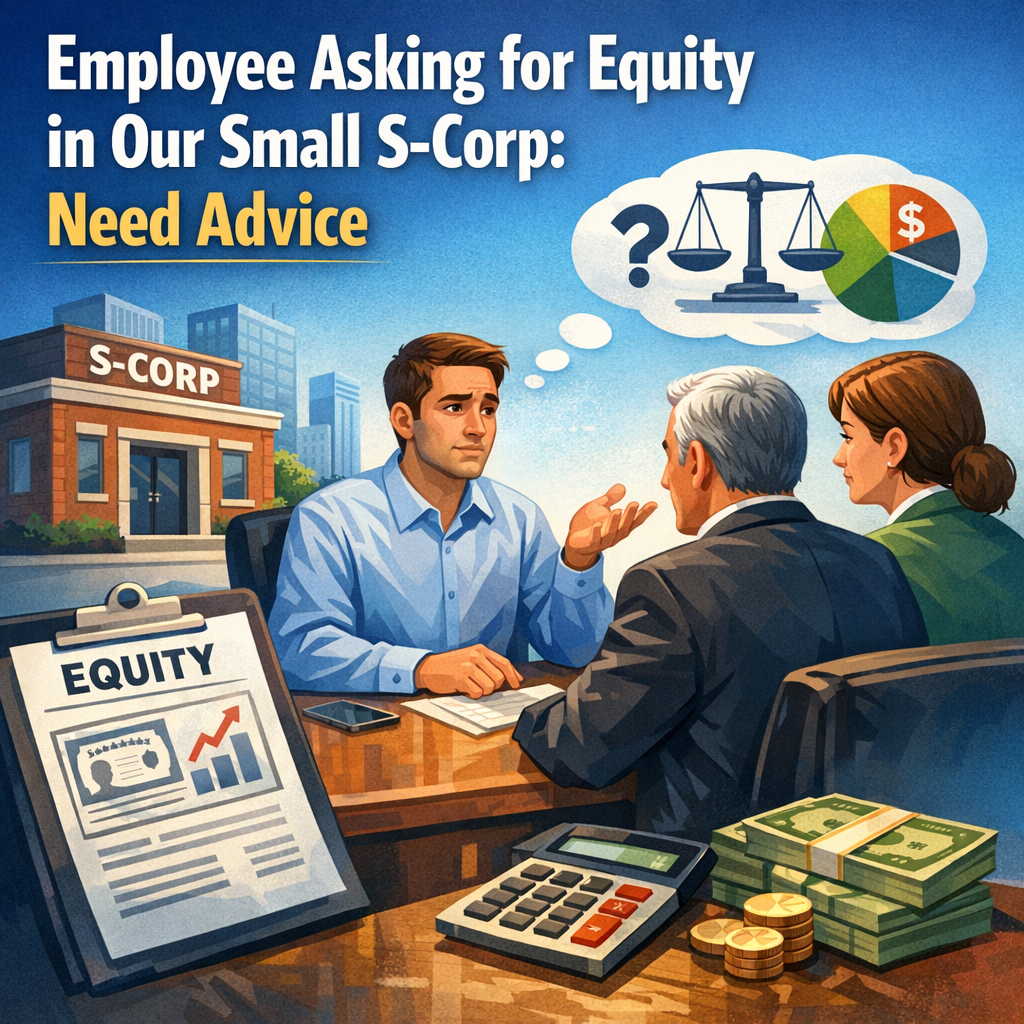
The Weight of Equity Decisions
Equity is one of the most powerful—and misunderstood—tools in a founder’s toolkit. It can align incentives, reward loyalty, and build long-term commitment. But used carelessly, it can just as easily create tension, dilute control, and introduce risks that are hard to unwind. If you’ve ever had an employee ask for equity, especially in the early stages of your company, you’ve likely felt the weight of that decision.
This article explores when it makes sense to offer equity, how to distinguish between a strong employee and a true owner, and what to do when expectations around ownership begin to fracture your team. Along the way, we’ll unpack a real-world scenario many founders can relate to—and the lessons hidden inside it.
By the end, you’ll have a clearer framework for thinking about equity, protecting your company’s future, and making confident decisions when emotions and business collide.
What Equity Really Represents
At its core, equity is not just compensation—it’s ownership. And ownership comes with a fundamentally different set of expectations than employment.
Founders typically take on significant early risk: they invest capital, forgo salaries, work long hours, and assume legal and financial liability. Equity is the reward for that risk. Employees, on the other hand, are compensated for their time and output, usually without bearing those same risks.
This distinction is where many misunderstandings begin. An employee who joins early may feel emotionally invested and believe that longevity alone justifies ownership. But from a structural perspective, “being there early” is not the same as “building from zero under risk.”
In the scenario outlined above, the administrative hire contributed to operations but did not share in the initial financial or strategic burden. That doesn’t diminish their value—it simply places their role in a different category.
Equity should not be treated as a reward for loyalty alone. It’s a long-term alignment mechanism designed for people who actively shape the direction, growth, and risk profile of the company.
Employee vs. Owner Mindset
One of the hardest challenges founders face is distinguishing between a great employee and someone who should be an owner. The difference isn’t about how likable or dependable someone is—it’s about how they think and operate.
An owner:
- Thinks in terms of long-term value creation, not short-term compensation
- Takes initiative without being asked and solves problems beyond their role
- Accepts uncertainty and risk as part of the journey
- Acts in the best interest of the company, even when it’s difficult
- Demonstrates accountability at a strategic level, not just a task level
An employee—even a strong one—typically operates within defined responsibilities and expects clear compensation in return.
In the case presented, a key signal emerged during the equity discussion: the employee admitted to “quiet quitting” for six months. This behavior is fundamentally misaligned with ownership thinking. Rather than leaning in and creating value, the individual reduced effort based on perceived fairness. That’s not how owners behave—especially in early-stage companies where effort is often asymmetrical and fluid.
This moment reveals an important truth: how someone acts when they don’t get what they want tells you more than how they perform when things are going well.
When Equity Makes Sense—and Alternatives
There are absolutely times when granting equity to non-founders is the right move. Many successful companies use equity to retain key talent and incentivize long-term growth. But timing and structure matter.
Equity typically makes sense when:
- The individual is taking on a leadership role that directly impacts company growth
- They are expected to make decisions that influence strategy, not just execution
- Their contributions are difficult to replace and deeply embedded in the business
- They are willing to accept trade-offs, such as lower salary in exchange for upside
- There is clear alignment on vision, values, and long-term commitment
Even then, equity is rarely given outright. It is usually tied to a vesting schedule (for example, four years with a one-year cliff), ensuring that ownership is earned over time.
In early-stage startups, it’s also common to use alternatives like:
- Profit-sharing agreements
- Performance-based bonuses
- Phantom equity or stock appreciation rights
These structures allow founders to reward and motivate employees without immediately altering the ownership structure of the company.
A helpful visual here would be a comparison chart showing “Equity vs. Profit Sharing vs. Bonuses” to clarify trade-offs.
Red Flags and Alignment Breakdowns
Not all equity requests are created equal. Some are thoughtful and aligned with company growth. Others reveal deeper issues that need attention.
In this case, several red flags stand out:
- A sense of entitlement to ownership without corresponding risk
- Dismissal of alternative compensation structures
- Adversarial behavior during negotiations
- Admission of intentionally reduced performance (“quiet quitting”)
These signals suggest a breakdown in trust and alignment. Equity should strengthen relationships, not strain them.
When an employee becomes transactional or combative about ownership, it often indicates they are viewing equity as a prize to win rather than a responsibility to earn.
A real-world parallel can be seen in early-stage startups where premature equity grants lead to “dead equity”—shares held by individuals who are no longer contributing meaningfully. This can complicate fundraising, decision-making, and future hiring.
An infographic showing “Healthy vs. Unhealthy Equity Conversations” could be especially useful in this section.
Retaining Talent Without Giving Away the Company
Founders often worry about retaining valuable team members without offering equity. The good news is that equity is just one of many tools.
To retain and motivate key employees:
- Create clear growth paths with increasing responsibility
- Tie compensation to measurable performance outcomes
- Offer leadership opportunities that expand their influence
- Build a strong company culture that values contribution and transparency
- Revisit compensation regularly as the company grows
Most importantly, set expectations early. If equity is not on the table, say so clearly. If it might be in the future, define what milestones or roles would justify it.
Ambiguity is often what leads to tension. Clarity, even when it’s disappointing, is far more sustainable.
A step-by-step framework for handling equity requests could be helpful here, such as:
1. Evaluate the role and impact of the employee
2. Assess cultural and behavioral alignment
3. Consider alternative incentives
4. Align internally with co-founders
5. Communicate a clear and consistent decision
Equity decisions are rarely just about numbers—they’re about trust, alignment, and the future of your company. Here are a few grounded principles to keep in mind:
- Don’t rush equity decisions under pressure or emotion
- Protect the cap table early—it becomes harder to fix later
- Reward contribution, but differentiate between effort and ownership
- Pay close attention to behavior during negotiations—it’s predictive
- Always align with your co-founder before making commitments
In the scenario we explored, the ultimate decision to part ways reflects a difficult but necessary reality: not every valuable employee is meant to be a long-term partner.
Equity is one of the most consequential decisions a founder can make. Done right, it creates alignment, loyalty, and shared success. Done poorly, it introduces friction, confusion, and long-term complications.
The key is understanding that ownership is not a reward—it’s a responsibility. And not everyone who contributes to your company is meant to carry that responsibility.
As your business grows, you’ll face more of these decisions. The goal isn’t to avoid them, but to approach them with clarity, structure, and a firm understanding of what your company needs to succeed.
When in doubt, remember: you can always offer more later—but you can’t easily take equity back.
References and Further Reading
- “Venture Deals” by Brad Feld and Jason Mendelson (for understanding equity structures)
- Y Combinator’s Startup Library (guides on equity and hiring)
- Harvard Business Review articles on compensation and incentives
- Carta’s resources on startup equity and cap tables
These resources provide deeper insight into how successful companies think about ownership and compensation, helping you make more informed decisions as a founder.